Insurance claims
Insurance claims, explained straight.
First, the thing everybody gets wrong: a free inspection is not a claim. It does not open one, it does not notify your carrier, and it does not obligate you to file. Everything below is what happens if you decide to.
Still working out whether you have damage? Start here. What hail actually does to a shingle.
What we do, and what we do not do
This is the only description of our role in a claim we give anybody — the same words on the phone, in the contract, and here. It does not get softened for a nervous homeowner or widened for a keen one.
What we do
- Inspects your roof at no charge and tells you plainly whether we see storm damage
- Documents what we find with dated photographs and a written scope of work
- Meets your insurance adjuster at your home and walks the roof at the same time they do
- Gives you and your carrier the identical scope, line items and photo report — you always have every document we have
- Submits supplement documentation to your carrier when the approved scope misses code-required items, for the carrier to determine
- Pulls the permit, builds the roof, and stands behind the workmanship for ten years
What we do not do
- Negotiate or adjust your claim on your behalf — that is public adjusting, and it is a licensed activity in Georgia
- Act as your public adjuster, your attorney, or your representative with your insurance company
- Waive, absorb, discount, rebate, credit, or otherwise reduce your deductible in any form
- Guarantee that your claim will be approved, or predict what your carrier will pay
- Advise you on whether to file a claim — that decision is yours, with your agent
- Give legal advice about your policy, your deadlines, or your rights under it
How it actually goes
The same sequence we run on every job, with the two steps that only happen when you are filing a claim.
01
The call and the free inspection
Someone from here comes out — a named project manager who lives in the area you live in, not a canvasser working a neighborhood — gets on the roof, and looks. It takes about forty-five minutes. It is free, and it commits you to nothing. Worth being explicit about the part people worry about: a free inspection is not an insurance claim, it does not open one, and it does not notify your carrier of anything.
02
What we found, in writing
Dated photographs of every slope, every penetration and anything we counted, plus a written scope where there is something to scope, plus a plain answer in one of three words: damage, no damage, or borderline. If it is borderline we will tell you what makes it borderline rather than rounding it in whichever direction suits us.
You get: Photo report and written scope
03
Your decision: insurance or retail
If there is storm damage you may have a claim. That call is yours and your agent's — we can tell you what is on your roof and we cannot tell you what to do about your policy, and any roofer who does is advising you on a contract they have not read. If you would rather just buy a roof, we price it and skip the next two steps entirely.
04
Insurance path
The adjuster meeting
Your carrier sends an adjuster out. Your project manager is on the roof at the same time, with the same photographs and the same measurements, so that everybody present is looking at the same roof and describing it in the same terms. We are there to document and to answer questions about what we found. We are not there to argue with anyone about your claim.
You get: Scope comparison
05
Insurance path
Supplements and approvals
A carrier's first scope frequently misses items the building code or the manufacturer's instructions actually require — ice-and-water membrane where code calls for it, drip edge, ridge ventilation, decking at the rate it genuinely needs replacing rather than a nominal allowance. Our supplements specialist documents those items with the code reference and submits them to your carrier, for the carrier to determine. That is documentation, not negotiation, and the distinction is a legal one in Georgia rather than a stylistic one.
You get: Supplement packet
06
Permit, materials, and the build
Our permit technician pulls the permit — and where a jurisdiction has not published an answer, gets one in writing before anything is ordered. Materials are delivered to your driveway on plywood, not to your lawn. Most residential roofs are one day; we tell you in advance if yours is two. You get a start time, and somebody stays until the drive, the lawn and the beds have been magnet-swept.
You get: Permit and completed roof
07
Final inspection, registration, warranty
The county or city final gets scheduled and passed. The manufacturer's material warranty is registered within forty-eight hours and the registration comes to you. And the ten-year workmanship warranty goes in your hand, with its exclusions printed on the same page as its coverage, because a warranty you have to ask for the exclusions to is not a warranty.
You get: Warranty certificate
The adjuster meeting
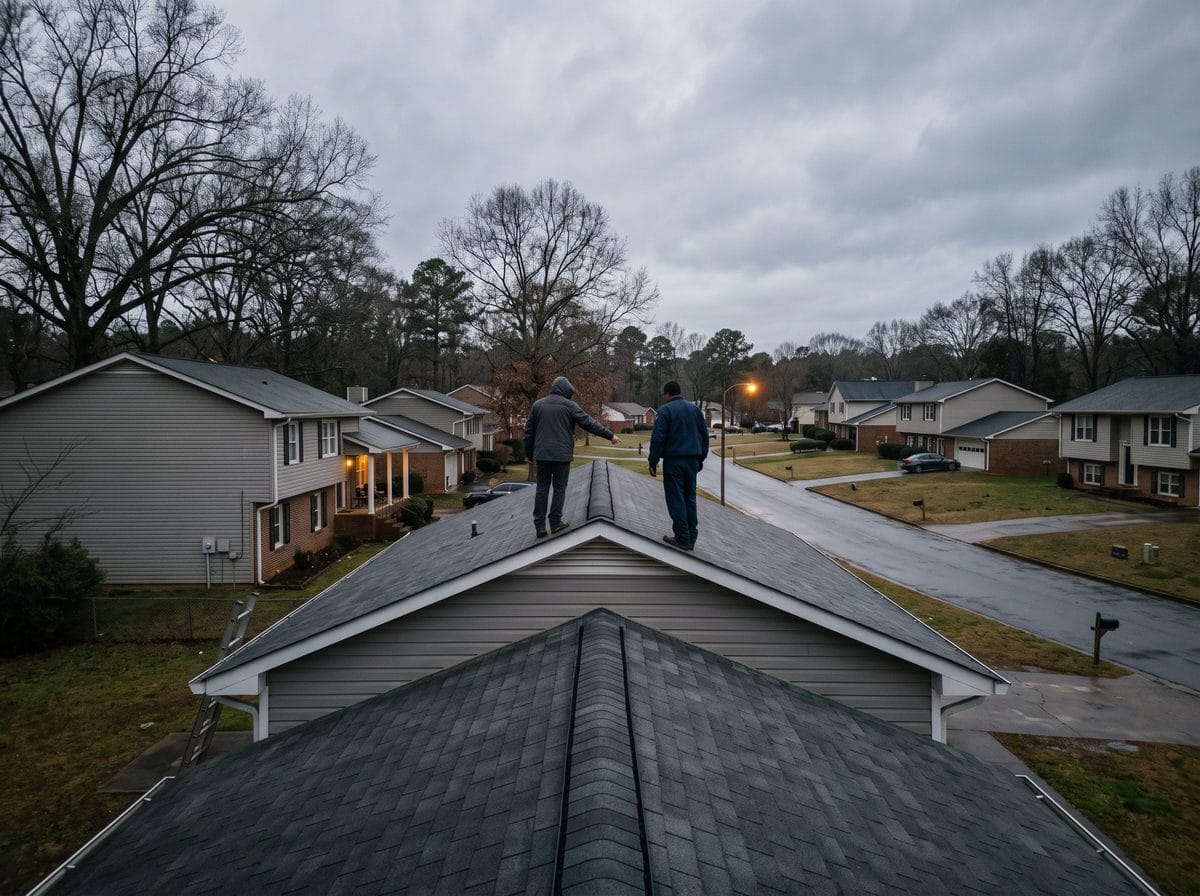
Your carrier sends somebody out to look at the roof and write a scope. That person works for your carrier, which is not a criticism of them — it is simply who they work for, and it is why we are also there.
Your project manager is on the roof at the same time, with the photographs already taken, the test squares already chalked and the measurements already done. The point is not to argue. The point is that everybody present is looking at the same roof and describing it in the same terms, so that the two documents produced afterwards are comparable line for line.
What we bring: the dated photo report, the written scope, the measurements, and the code references for anything that will need one. What we do not bring is an opinion about what your carrier ought to pay.

The supplement, in plain words
A carrier's first scope is written fast and it frequently misses items the building code or the manufacturer's installation instructions require — ice-and-water membrane where the code calls for it, drip edge, ridge ventilation, and decking at the rate it genuinely needs replacing rather than a nominal allowance.
A supplement is documentation of those items, with the reference attached, submitted to your carrier for the carrier to determine. Renee does that work here full time.
Note the shape of that sentence. It is documentation submitted for a determination. It is not an argument, it is not advocacy on your behalf, and it is not a negotiation — because that would be public adjusting, which is licensed work in Georgia and which we do not do.
About your deductible
Your deductible is the part of a covered loss you are responsible for. It is set by your policy, it is between you and your carrier, and it is not ours to move.
Georgia law makes it a crime for a contractor to pay, waive, rebate, absorb or offer to cover a homeowner's insurance deductible — including by inflating the estimate, adding a line item that is not real work, giving a "discount" that happens to equal the deductible, or trading it for a sign in your yard. It is insurance fraud, and both the contractor and the homeowner can be exposed by it.
Any roofer who offers to make your deductible disappear is telling you exactly what kind of company they are, and you should get their name.
What we will do: tell you what your deductible is likely to be, help you understand the carrier's paperwork, and bill exactly what the scope says. That is the whole of it.
Timelines, and what we will not tell you
Homeowner policies carry prompt-notice provisions. They are usually shorter than people expect and they vary by policy.
We are not going to tell you what yours are. Reading your contract and telling you what it obliges you to do is legal advice about your policy, and we are a roofing company. Read it, or call your agent and ask — today rather than next month.
What we will say is the operational version: evidence gets worse with time, storm dates get harder to establish, and the roof that was obviously damaged in April is a harder conversation in December. That is a fact about roofs, not a statement about your rights.
What you end up holding
Six documents, all of them yours, all of them the same ones we work from.
- A dated photo report
- Every slope, every penetration, every impact we counted, with the date on it. You get the same file your carrier gets.
- A written scope of work
- Line items, quantities and what each one is for — in the same form the carrier's estimate arrives in, so the two can be laid side by side.
- A material list
- What is going on your roof, by name and quantity. Nobody should have to ask what they bought.
- The permit
- Pulled in our name against your address, with the jurisdiction's own answer about whether it was required attached to it.
- A final invoice that matches the scope
- The same line items you were shown, at the rates on your contract. Decking is the only variable and it is priced per sheet up front.
- The workmanship warranty certificate
- Ten years, in writing, with the exclusions printed on the same page as the coverage.
Questions people ask in the first week
What is a supplement, and why did I get another number?
A carrier's first scope is written quickly and frequently misses items the building code or the manufacturer's instructions require — ice-and-water membrane where code calls for it, drip edge, ridge ventilation, or decking at the rate it genuinely needs replacing rather than a nominal allowance. A supplement is documentation of those items, with the reference attached, submitted to your carrier for the carrier to determine. The number changes because the scope changed, not because anybody argued.My claim was denied. What now?
First, read the denial letter properly — carriers deny for very different reasons and the reason decides what is possible. If new or better documentation is genuinely available we can re-document the roof and give it to you, and you can request a re-inspection through your carrier. What we will not do is appeal on your behalf or contact your carrier as your representative, because that is licensed work in Georgia and we are not licensed to do it. If you want somebody in your corner in that sense, what you want is a licensed public adjuster or an attorney.Does having a claim raise my rates?
We genuinely do not know, and neither does any other roofer. That is between you and your carrier, it depends on your policy, your history and the carrier's own rules, and it is exactly the question to ask your agent before you file rather than after. Any contractor who answers this one confidently in either direction is guessing — usually in the direction that gets them the job.What is actual cash value versus replacement cost value, and why does it matter to me?
Broadly: an actual-cash-value settlement accounts for the age and condition of what was damaged, and a replacement-cost policy can release a further amount once the work is actually done and invoiced. Which one you have, and what conditions attach to it, is written in your policy and we do not read it for you. What we can tell you is that it changes the sequence of the money rather than the roof, and that it is worth understanding before you sign anything with anybody.What do I actually have to pay?
Your deductible, and anything you choose above the approved scope — an upgraded system, a color change, work we found that is not storm-related. Those are itemized separately on your contract before you sign it, never rolled in. What you will not find on our paperwork is a line item that exists to change the arithmetic on your share of the loss.
Free inspection
Request an inspection window
Three steps — four if there has been a storm. About ninety seconds.
Print it and put it on the counter next to the flyer that came through the door. That is the comparison we would pick.